Friday, May 30, 2008

Maternal employment

Today, most mothers are employed, and the majority of employed mothers are working full time. This is especially true of mothers of older children, but even among mothers of infants, half (51.9%) are employed and by far most of these mothers are employed full-time.

These high levels of maternal employment reflect a substantial social change since the 1960s and 70s. Yet, maternal employment has not grown substantially since the late 1990s, despite the passing of legislation (e.g. the Family Medical Leave Act, 1993) that should have improved women’s ability to combine paid work with child rearing.

Trends in maternal employment spark intense controversy between those who argue that women should work, either for greater self-fulfillment or because it is very difficult for most families to make ends meet without the mom working. Others, take offense at the notion that caring for children is not noble or worthy, sometimes demeaning mothers who do decide to take one paid employment. I can understand this perspective, since we often devalue care work.

A consequence of this controversy is that we often
scrutinize trends to find evidence that women are starting to forgo career for family (or vice versa). Either out of economic necessity or philosophical differences, diversity is here to stay.

Thursday, May 29, 2008

Aging Population

The population of the United States is aging remarkably slowly. Today 12.4 percent is over age 65 and this actually represents a decrease from 12.6 percent in 1990. In contrast, Japan is experiencing a fairly rapid aging of its population. In 2000, 17.3 percent of the population was age 65+, up from 12.0 percent 10 years earlier. We can expect that the United States will age a little bit faster as the baby boomers (born 1945-1964) reach their golden years, but nothing like Japan.

Wednesday, May 28, 2008

Demographic data

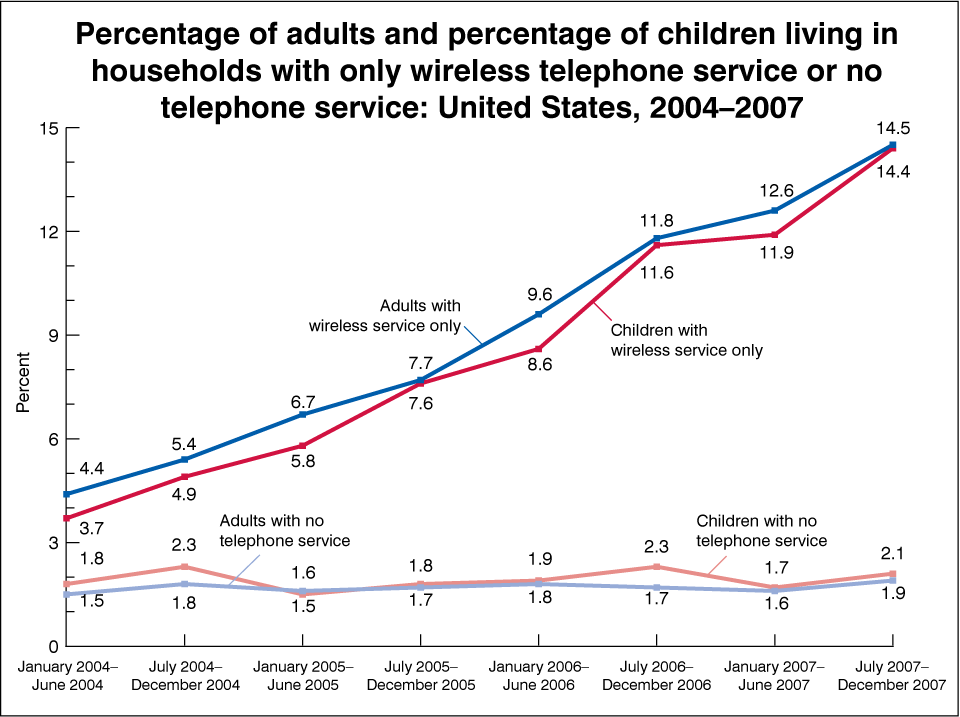
According to a recent report by the National Center for Health Statistics, almost 1 out of 6 United States residents lives in a household without a landline. This has important implications for the way basic demographic data are collected, particularly for young adults (age 18-24). In an attempt to maintain data quality, some survey organizations are starting to add cell phone numbers to their call lists.

Not including cell-phone only households is not a problem if these households are similar to households with landlines, but this same study found for instance that binge drinking (having 5 or more drinks in an episode) was twice as common among the cell-phone only households.

Click on this picture to actually see it:


Tuesday, May 27, 2008

Variation in Education

The American Community Survey is a good source of up-to-date information on population characteristics. For example, they have state ranking tables that show facts such as median age, the sex ratio, or percentage of the population with a bachelor’s degree. Washington D.C. has an exceptionally high proportion of the population with a bachelor’s degree. It also has the highest rate of child poverty. That is, Washington D.C. has an exceptionally high level of inequality, but this is not really a fair comparison and we would likely find similarly high levels of inequality in New York city or many other large urban areas.


"States" ranked by percentage of Population with a Bachelor's Degree
West Virginia 17
Arkansas 18
Mississippi 19
Kentucky 20
Louisiana 20
Nevada 21
Alabama 21
Indiana 22
Tennessee 22
Oklahoma 22
South Carolina 23
Wyoming 23
Ohio 23
Idaho 23
Iowa 24
Missouri 24
Michigan 25
Texas 25
North Carolina 25
South Dakota 25
Wisconsin 25
Florida 25
New Mexico 25
Pennsylvania 25
Arizona 26
North Dakota 26
Maine 26
Georgia 27
Alaska 27
Nebraska 27
Delaware 27
Montana 27
Oregon 28
Kansas 29
Utah 29
Illinois 29
California 29
Rhode Island 30
Hawaii 30
Minnesota 30
Washington 31
New York 31
New Hampshire 32
Vermont 32
Virginia 33
New Jersey 33
Connecticut 34
Colorado 34
Maryland 35
Massachusetts 37
Wash. D.C. 46

Monday, May 26, 2008

Remembering Veterans

Memorial day is an opportunity to remember those who have died in the military service. By the most recent count I can find, 4,081 men and women in military service have died in Iraq and 432 have died in military service in the Afghanistan area since 2001. Knowing how difficult it is to lose these lives helps put into perspective the 11,260,000 men and women who died in military service to the United States in World War II and the 58,209 who died in Vietnam.


Generally speaking more recent generations have borne a much lighter military burden than older generations. According to the 2006 American Community Survey about 20% of the male population in the United States has served some time on active duty in the U.S. Army, Navy, Air Force, Marine Corps, or the Coast Guard.* This proportion is much lower for younger generations than those who were old enough to fight in WW II.

These generational differences will likely shape the debates between Obama and McCain this summer. McCain, who will turn 73 this August, is of a generation where the majority of men served in the military. Obama is 46 and of a generation where military service was much less common.


* The full definition of veteran that the Census bureau uses is as follows: a person 18 years old or over who has served (even for a short time), but is not now serving, on active duty in the U.S. Army, Navy, Air Force, Marine Corps, or the Coast Guard, or who served in the U.S. Merchant Marine during World War II. People who served in the National Guard or military Reserves are classified as veterans only if they were ever called or ordered to active duty, not counting the 4-6 months for initial training or yearly summer camps.